Arterra Pet Science
For a marketing agency: a same-night WordPress product page that kept paid traffic converting while a client’s Shopify cart was broken, then landing pages and a custom product selector.
The client
Elevate Digital is a marketing agency that runs paid traffic for e-commerce brands. One of its clients is Arterra, which sells a daily dental chew for dogs on Shopify.
The urgent problem
In July 2025 the agency messaged me in a hurry. Arterra’s Shopify cart had a problem, but the agency was already paying for traffic to the product page. They needed a stand-alone copy of that product page on WordPress, on their own server, that looked exactly the same and sent each of the three pack sizes straight to the correct Shopify checkout. And they needed it that day.
I confirmed the scope (one product, three variants, no menu or other pages, design identical to the original), they sent the three checkout links and a short video, and I started that evening. The page was finished overnight, with the variant selector rebuilt in custom code so each choice points to its own checkout link. While testing, I also found pop-ups on the page that blocked clicks on laptops, and fixed them.
Landing pages and a custom selector
Four months later the agency came back with a larger brief: two new landing pages from their Figma designs, called “Science first” and “Founder first”, and a new version of the product page. I delivered the two Figma pages first so they could launch while I worked on the harder part.
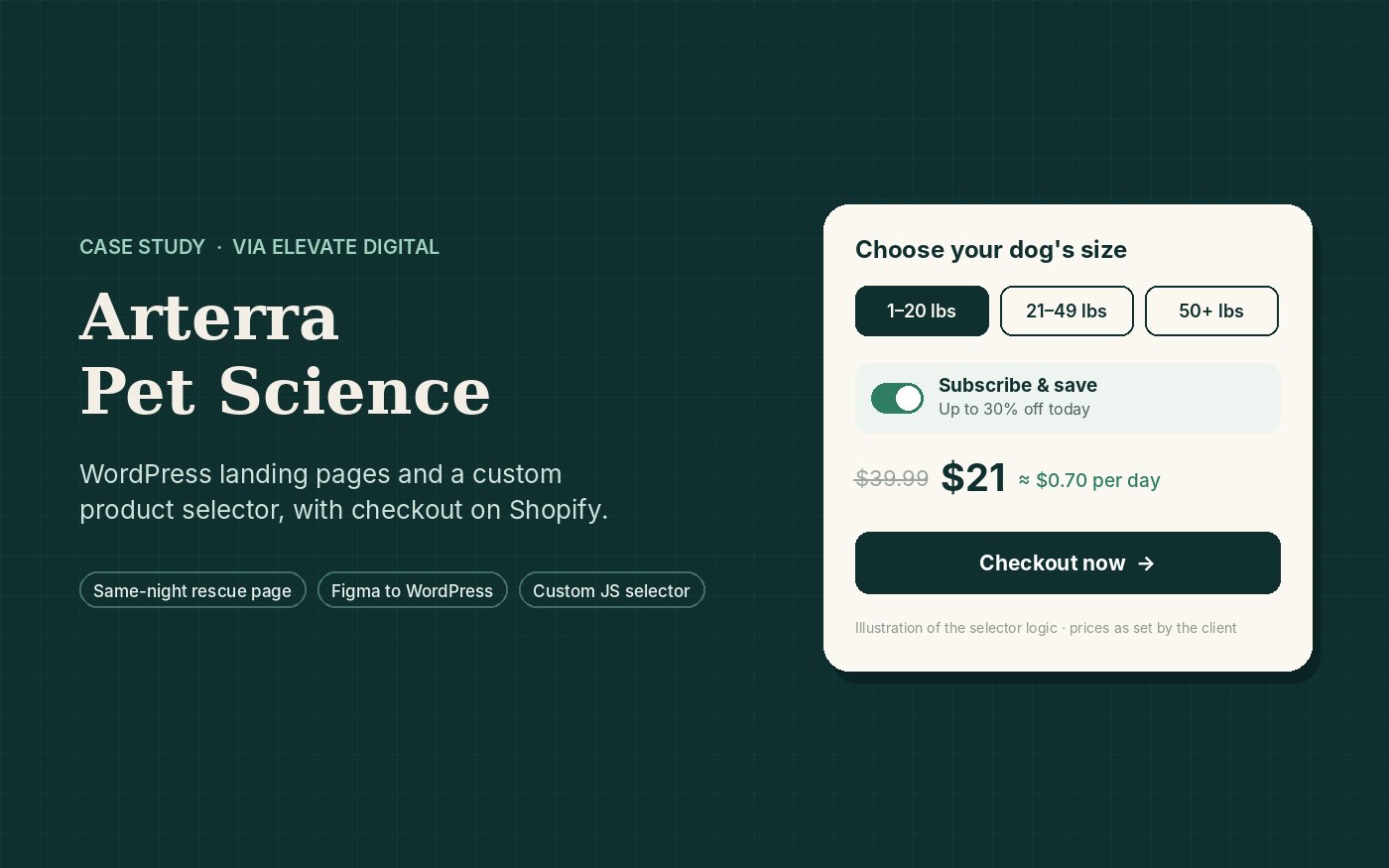
The new product page needed a selector that existing plugins could not do, so I coded it: the buyer picks their dog’s size, switches between subscription and one-off purchase, and sees the original price crossed out, the saving, and the cost per day. Each combination links to its own Shopify checkout, and the agency can swap any link themselves after a short video I recorded for them. The agency then asked for many fine details, such as “up to 30% off” wording, removing “most popular” tags that did not make sense for a size-based choice, a working close button on the pop-up, and prices like $0.70 shown with two decimals. Each was done the same or next day.
Speed, and a lesson on live pages
PageSpeed Insights showed a Speed Index of 9.6 seconds, so the agency also ordered speed work. The first optimisation plugin minified the JavaScript that powers the selector and broke it on the live page while traffic was running. I traced the problem to that plugin and switched it off within the hour, then continued with safer optimisation, such as resizing images. When a compressed hero image looked too soft on mobile, I restored a sharper version, because on a product page trust matters more than a few kilobytes.
More work from the same agency
The agency has since sent me more pages for other brands: a two-page funnel built from Figma in December 2025, and in January 2026 a landing page they needed within 24 hours. I built it overnight and sent it before the deadline, then worked through the client’s revisions over the next two days.
What I delivered
- A same-night replica of a Shopify product page on WordPress, linked to Shopify checkout
- Two landing pages built from Figma in Elementor
- A custom-coded size, subscription and price selector with separate desktop and mobile layouts
- Speed optimisation, and fixes after a plugin conflict
- Further Figma-to-WordPress pages for other brands in the agency’s portfolio
These pages ran as temporary campaign pages and are no longer online, so the image at the top is an illustration of how the selector worked, not a screenshot.